
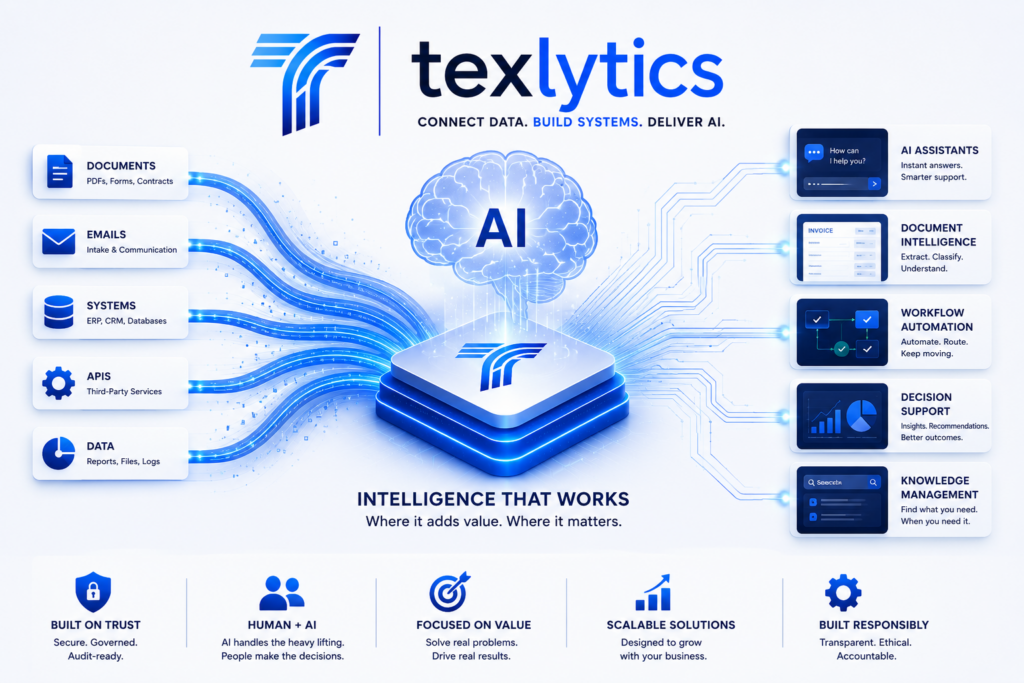
Practical AI. Built for Business.
Artificial Intelligence has enormous potential—but only when it’s applied to the right problems.
At texlytics, we help organizations move beyond AI hype by designing solutions that solve real business challenges. Whether it’s automating document processing, assisting employees, interpreting unstructured information, or providing intelligent recommendations, our focus is always the same:
Use AI where it adds value. Use software where it delivers certainty.
Technology should help people make better decisions—not replace them.
AI Starts with Good Data
The most advanced AI model in the world cannot compensate for disconnected systems or unreliable information.
That’s why every successful AI initiative begins with a strong data foundation.
Before implementing AI, we ensure your business has:
- Connected systems
- Reliable data
- Clear business processes
- Governed information
- Secure access
- Well-defined objectives
AI built on poor data produces poor decisions.
AI built on trusted data becomes a force multiplier.
Our Philosophy
At texlytics, we believe AI should complement human expertise—not replace it.
We use artificial intelligence where interpretation, reasoning, or summarization creates value.
We rely on deterministic software and business rules where consistency, auditing, validation, and repeatability are essential.
The result is intelligent systems that remain transparent, reliable, and accountable.
What We Build
AI Assistants
Give employees immediate access to company knowledge through conversational AI.
Examples include:
- Internal knowledge assistants
- Customer support assistants
- Operations assistants
- ERP assistants
- Executive reporting assistants
- “Ask Tex” style business assistants
Instead of searching through documents or multiple systems, employees simply ask a question and receive meaningful answers.
Document Intelligence
Many businesses spend countless hours processing emails, PDFs, invoices, purchase orders, contracts, and forms.
AI can automatically:
- Read documents
- Extract key information
- Classify content
- Route workflows
- Identify missing information
- Flag exceptions
- Prepare records for human review
The human still makes the final decision when appropriate.
AI simply eliminates repetitive work.
Intelligent Workflow Automation
Traditional automation follows predefined rules.
AI enables workflows that can understand language, recognize patterns, summarize information, and make recommendations before handing work back to employees.
Examples include:
- Email classification
- Vendor onboarding
- Customer intake
- Ticket routing
- Proposal generation
- Contract review
- Sales assistance
- Meeting summaries
Decision Support
Some business decisions require context that traditional software cannot provide.
AI can assist by:
- Summarizing operational data
- Highlighting trends
- Explaining anomalies
- Recommending next steps
- Comparing historical outcomes
- Prioritizing work
- Identifying operational risks
These recommendations support decision-makers rather than replacing them.
Knowledge Management
Most organizations possess valuable institutional knowledge spread across:
- Documents
- Emails
- Policies
- Procedures
- ERP systems
- CRM systems
- Shared drives
- Wikis
- Project documentation
AI makes that knowledge searchable through natural language instead of folders and file names.
AI Integration
AI should not exist as another disconnected application.
We integrate AI into the systems your employees already use.
Examples include:
- ERP platforms
- CRM systems
- Microsoft Teams
- Mobile applications
- Customer portals
- Internal dashboards
- Web applications
The best AI often feels invisible because it appears exactly where work is already happening.
Responsible AI
Successful AI requires more than choosing a model.
Every implementation should consider:
- Data governance
- Security
- Privacy
- Human oversight
- Auditability
- Accuracy
- Transparency
- Bias mitigation
- Regulatory compliance
We build AI solutions with these principles from the beginning—not as an afterthought.
What AI Shouldn’t Do
Not every problem requires artificial intelligence.
In many cases, traditional software is faster, simpler, less expensive, and easier to maintain.
For example:
Use business rules for:
- Calculations
- Validations
- Approvals
- Routing
- Compliance
- Auditing
- Financial transactions
- Inventory updates
Use AI for:
- Reading documents
- Understanding language
- Summarizing information
- Identifying patterns
- Generating recommendations
- Conversational interfaces
Choosing the right tool is just as important as choosing the right technology.
Preparing for AI
Many organizations want AI before they’re technically ready.
We help clients prepare by:
- Connecting business systems
- Improving data quality
- Eliminating information silos
- Building data pipelines
- Creating centralized reporting
- Documenting business processes
- Establishing governance
A strong foundation today makes future AI initiatives significantly more successful.
Why texlytics?
Many firms begin every conversation with artificial intelligence.
We begin with your business.
Only after understanding your people, processes, systems, and data do we determine where AI can genuinely create value.
That approach produces solutions that employees trust, executives understand, and organizations can maintain for years—not just impressive demonstrations.
AI That Evolves with Your Business
Artificial intelligence is changing rapidly.
Our approach is platform-neutral and architecture-driven, allowing your organization to adopt new models, new capabilities, and new technologies without rebuilding your entire solution.
As your business evolves, your AI should evolve with it.
Build AI That Solves Real Problems
Whether you’re exploring AI for the first time or looking to integrate intelligent capabilities into your existing systems, texlytics can help you identify practical opportunities that deliver measurable business value.
Let’s build AI that works for your business—not the other way around.
Contact texlytics to schedule a consultation.