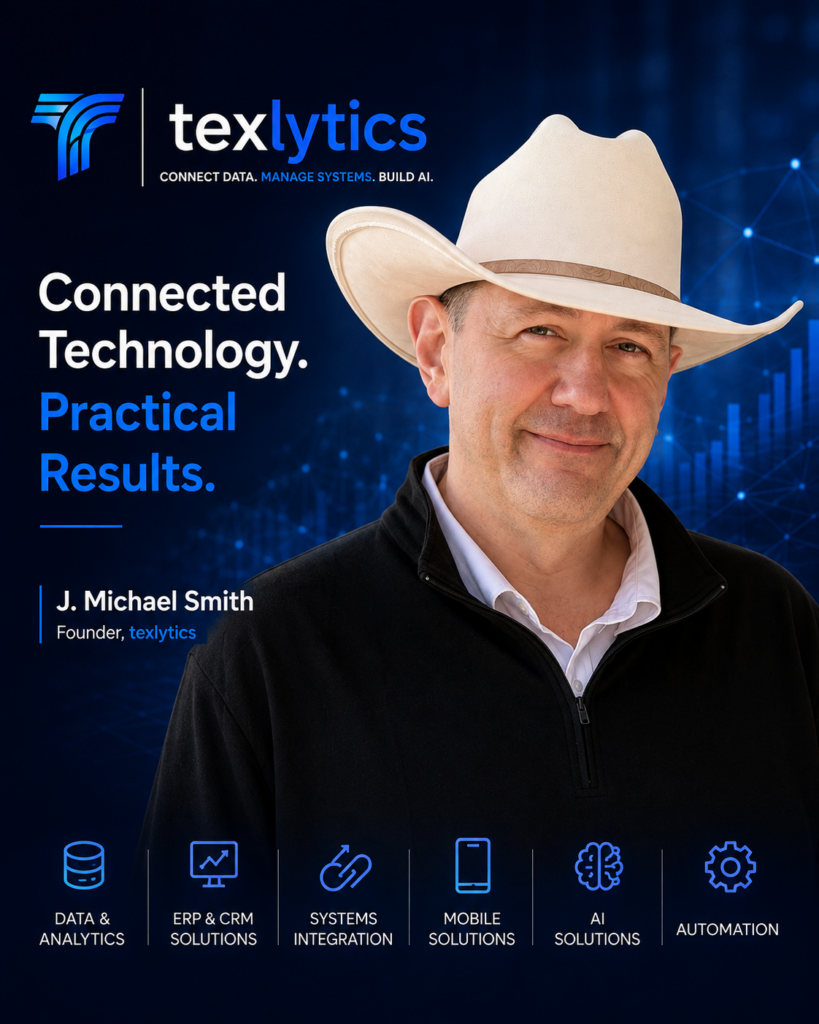
J. Michael Smith
jmichaelsmith@texlytics.com
Founder, texlytics
I founded texlytics because I believe businesses deserve technology that works together, adapts to the way they operate, and gives them control of their own information.
Too many organizations are forced to work around their technology instead of having technology work for them. Systems become disconnected. Data gets duplicated. Manual processes fill the gaps. Every new challenge seems to introduce another application, another login, another spreadsheet, another integration, or another workaround.
Eventually, the technology that was supposed to simplify the business becomes part of the problem.
It doesn’t have to be that way.
My career has been spent at the intersection of business and technology, designing data platforms, integrating enterprise systems, modernizing business applications, automating workflows, and helping organizations make better decisions with trusted information.
Along the way, I’ve learned something important:
Technology projects rarely fail because of the technology itself. They fail because they solve the wrong problem.
That’s why my approach has always been business-first.
Before writing code, selecting a platform, or recommending software, I want to understand how the organization actually works. Where does information originate? Where does it need to go? Where does it break down? What are people doing manually? What is getting entered twice? What doesn’t fit anymore? And, most importantly, what should success actually look like?
Only then should we talk about technology.
At texlytics, we help organizations:
- Connect data across systems
- Implement and manage ERP and CRM platforms
- Integrate business applications and APIs
- Automate repetitive business processes
- Build custom web and mobile solutions
- Extend systems around the way the business actually operates
- Apply artificial intelligence where it delivers real value
Our philosophy is simple:
Connect Data. Manage Systems. Build AI.
That order matters.
Artificial intelligence is extraordinarily powerful, but AI isn’t the foundation.
Trusted data is.
Connected systems are.
Well-designed business processes are.
Without those things, AI doesn’t solve the underlying problem. It simply gives you a more sophisticated way to interact with it.
We also believe businesses should have greater control over the technology they depend on.
Your data should remain accessible to you.
Your systems should be able to communicate with one another.
And when your business changes, your technology should be capable of changing with it.
That philosophy led us to Origo, our open business platform built around a straightforward idea:
Your business shouldn’t have to adapt to your ERP. Your ERP should adapt to your business.
Every organization develops processes, terminology, workflows, and information that are uniquely its own. Technology shouldn’t force those differences into somebody else’s predefined box.
When something new is needed, the answer shouldn’t automatically be another application, another disconnected database, or an expensive customization that only the software vendor can maintain.
The platform should be extensible.
The data should remain accessible.
And the business should retain control.
That’s the kind of technology we’re building with Origo, and it’s the same philosophy we bring to every texlytics engagement.
We also believe technology should remain understandable.
Business rules should remain deterministic where they need to be. Critical decisions should remain transparent. AI should assist people, not replace them. Systems should be maintainable, scalable, secure, and designed to evolve long after the initial implementation is complete.
Beyond client work, I regularly write about technology, business systems, leadership, AI, and digital transformation through the texlytics Charter and our technical publications. I’m particularly interested in open technologies, practical engineering, and architectures that give organizations more flexibility and ownership rather than creating greater dependency.
Technology will continue to change.
The principles behind good systems won’t.
My goal with texlytics is to help organizations build technology they can understand, control, and rely on, not just for the problems they have today, but for whatever comes next.
What I Believe
- The best technology is the technology people don’t have to think about.
- Business problems come before technology.
- Data should move automatically, not manually.
- Your data should remain accessible to you.
- Systems should adapt to the business, not force the business to adapt to them.
- AI should augment people, not replace them.
- Open architectures create long-term flexibility.
- Business rules should remain transparent and deterministic where they need to be.
- Good engineering is measured in years, not demos.
- Trust is earned through reliable delivery.