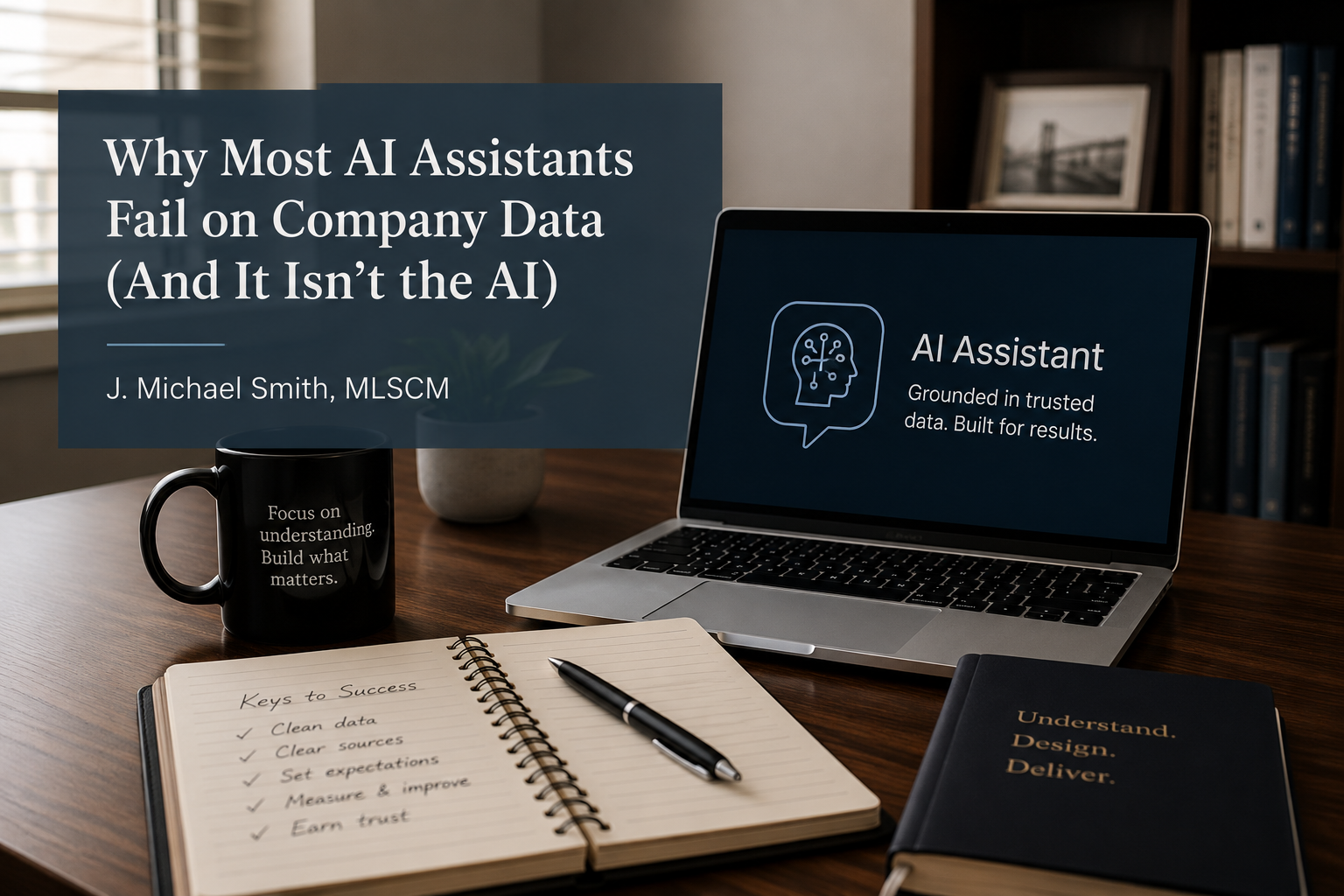
Why Most AI Assistants Fail on Company Data (And It Isn’t the AI)
Every AI demo starts with the model.
Every successful AI deployment I’ve worked on eventually becomes a data project.
That wasn’t obvious to me at first.
Like a lot of people, I started by building a Microsoft Copilot Studio agent and pointing it at our business documentation. It didn’t take long before I had something that looked impressive. Ask it a question, get an answer. It felt like one of those moments where you think, “This is going to change how people work.”
Then we let real users ask real questions.
That’s when reality showed up.
The biggest problem wasn’t that the AI occasionally made a mistake. It was that it made mistakes confidently. Someone would ask a perfectly reasonable question, and the agent would piece together information from multiple documents into an answer that sounded completely believable. Unfortunately, believable isn’t the same as correct.
In a business environment, that’s a dangerous combination. One confident wrong answer can erase the credibility built by twenty correct ones. People don’t remember all the times the AI helped them. They remember the one time it confidently pointed them in the wrong direction. After that, they’re back to emailing coworkers or searching SharePoint themselves.
At first, we assumed we had an AI problem. We experimented with prompts, adjusted instructions, and looked for ways to make the model reason better. The more we investigated, though, the more obvious it became that the model was doing exactly what we had asked it to do.
The real problem was the information we were giving it.
Our document library contained multiple versions of the same procedures. Drafts lived beside approved documents. File names made perfect sense to the people who uploaded them but not to anyone else. Employees naturally asked questions using the language they use every day, while the documentation often used formal terminology. None of those are AI problems. They’re knowledge management problems.
The breakthrough came when we stopped treating the project like an AI implementation and started treating it like a data quality initiative.
We cleaned up the document library. We removed obsolete versions, separated drafts from published content, improved metadata, and made sure there was a single authoritative version of important documents. Just as importantly, we instructed the agent to answer only from trusted sources, provide citations whenever possible, and simply say, “I don’t know,” when the answer couldn’t be supported.
Ironically, that last change probably did more to build trust than anything else we did. An AI that admits its limitations is far more believable than one that tries to answer every question.
Another lesson surprised me. Every time we changed the knowledge source or adjusted the instructions, we wanted to know whether the change actually improved the system. So we built a simple list of real questions that employees ask and used it every time we made a change.
It wasn’t sophisticated. It didn’t need to be.
It simply gave us a way to measure progress instead of relying on our impressions. Without that baseline, it’s easy to convince yourself the AI is getting better when all you’ve really done is change its behavior.
We also learned the value of saying no.
There’s a temptation to build an AI assistant that knows everything about the company. That’s an admirable goal, but it’s usually the wrong place to start. A focused assistant that consistently answers questions about one area of the business is far more valuable than a broad assistant that occasionally guesses. Users don’t expect perfection. They expect consistency.
Looking back, I would spend far less time experimenting with prompts and far more time preparing the data.
AI doesn’t magically organize your business.
It reveals how organized your business already is.
If your documentation is inconsistent, duplicated, outdated, or difficult for people to navigate, your AI assistant will faithfully expose those weaknesses. The model wasn’t the hard part.
The data was.
And honestly, I think that’s encouraging.
Cleaning up business knowledge is something organizations should be doing regardless of AI. The arrival of AI simply gives us another reason to finally tackle it.
In our case, the model didn’t become smarter.
The business knowledge did.
And once that happened, the AI suddenly looked a whole lot smarter too.