Don’t Buy Technology. Solve Problems.
A recent conversation on LinkedIn with Enterprise Systems & Data Architect Iosiv Popescu inspired this article. During a discussion about data migrations, he made an observation that stayed with me long after the conversation ended: “The business meaning never changed; only the source did.” The more I thought about that statement, the more I realized it applies to far more than data architecture. It applies to the way many organizations approach technology itself.
For years, I’ve watched companies begin major initiatives by talking almost exclusively about software. The conversations revolve around whether they need a new ERP, whether Microsoft Fabric is the right analytics platform, whether AI can automate their processes, or whether another application will finally solve the frustrations everyone has been living with. Those are all valid discussions, but I’ve come to believe they’re happening too early.
The question isn’t whether a particular technology is good. Most modern platforms are remarkably capable. ERP systems are better than they’ve ever been. Business intelligence tools can visualize almost anything. AI is advancing at an incredible pace. The problem isn’t usually the technology. The problem is that organizations often try to choose the technology before they fully understand the business problem they’re trying to solve.
I’ve seen reporting projects fail because no one could agree on what a number actually meant. Sales, Operations, and Accounting all believed they were reporting revenue correctly, yet each department had a different definition. They weren’t looking at bad data. They were looking at different business rules. Replacing the reporting platform wouldn’t have fixed that because the disagreement existed long before the first dashboard was ever built.
I’ve seen organizations prepare to replace an ERP because employees believed the system couldn’t support the business anymore. After spending time with the people actually doing the work, it became clear that the software wasn’t the obstacle. Years of workarounds, duplicate data entry, disconnected processes, and inconsistent business rules had slowly buried the capabilities that already existed. Installing a different ERP would simply have moved those same problems into a new application.
Over the years, I’ve also noticed another pattern. Every few years, a new technology captures everyone’s attention. It might be cloud computing, big data, blockchain, low-code platforms, or now AI. Organizations begin asking how they can use the technology before they’ve identified where it creates meaningful value. The excitement is understandable. New capabilities are exciting. Innovation is what moves our industry forward.
The risk comes when the conversation changes from “What problem are we trying to solve?” to “Where can we use this new technology?” Those are very different questions, and they often lead to very different outcomes.
I enjoy exploring new technology as much as anyone. If you’ve followed my writing, you know I’m genuinely excited about AI and where it’s taking us. But I’ve also learned that the newest technology rarely creates value on its own. Value comes from applying the right technology to the right business problem. Sometimes that’s the latest innovation. Sometimes it’s improving a process that’s been overlooked for years. Sometimes it’s simply connecting systems that already exist.
That, to me, is where the real work begins.
Before anyone recommends a product, designs an architecture, or starts writing code, someone needs to understand how the business actually operates. Where does information originate? Who owns it? Why do departments disagree? Which decisions are taking too long because people don’t trust the information they’re receiving? Those questions are far more valuable than asking which software is trending this year because they get to the heart of what the business is actually trying to accomplish.
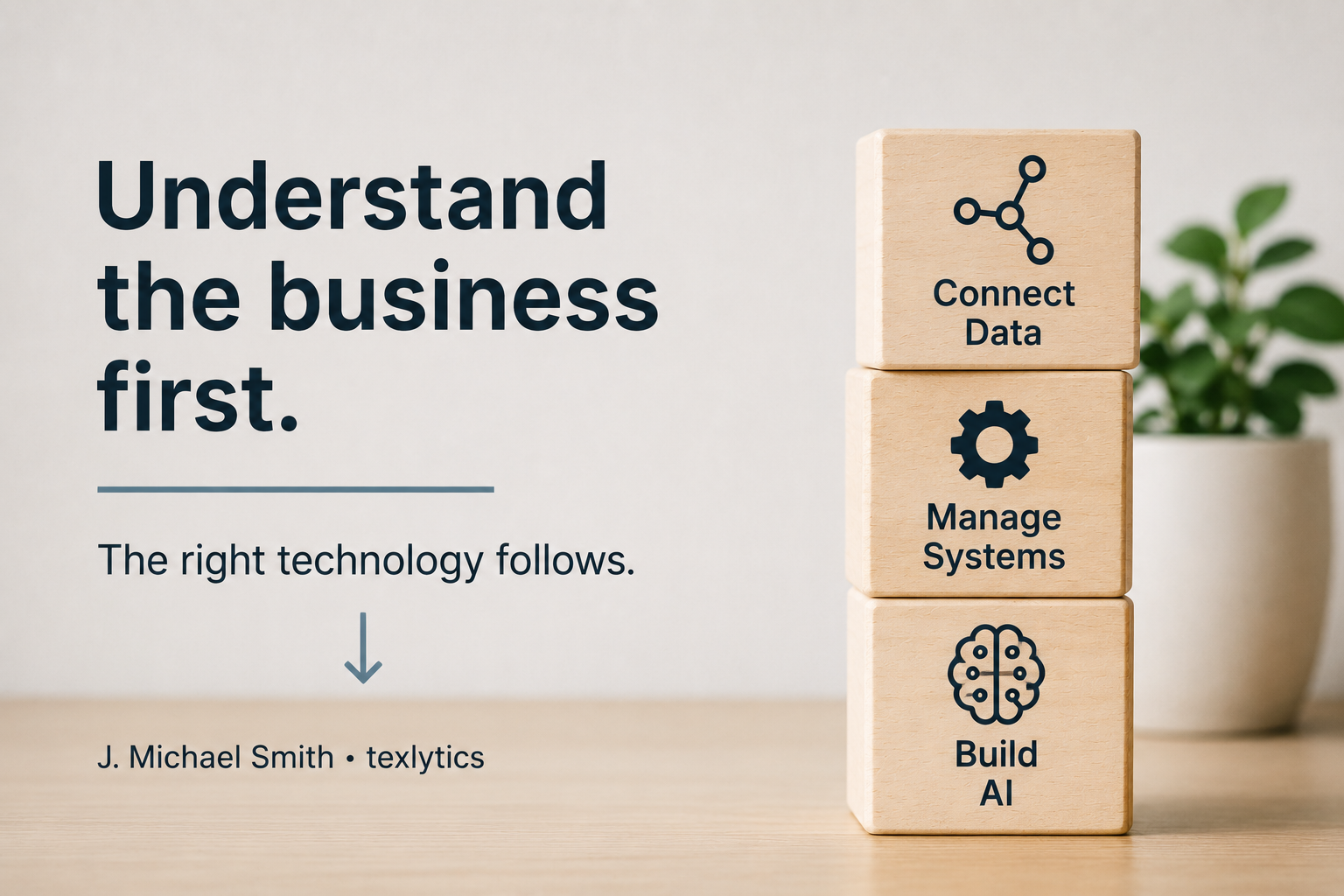
When you understand the business first, you naturally know what data needs to be connected, which systems need to be managed, and where AI can create real value.
This is one of the reasons I started texlytics with the philosophy I did. I don’t believe technology should lead the conversation. Technology should support the conversation. If we understand the business first, the technology decision usually becomes much easier. Sometimes that means implementing a new ERP. Sometimes it means building a semantic model that gives everyone a common understanding of the business. Sometimes it’s an integration project, an AI initiative, or simply redesigning a process that has grown unnecessarily complicated over time. The answer is different for every organization because every organization has a different story.
What doesn’t change is the order in which those decisions should be made.
Technology will continue to evolve. Five years from now we’ll all be talking about platforms and AI capabilities that don’t even exist today. Vendors will release new products, old systems will disappear, and today’s “must-have” features will eventually become tomorrow’s expectations. Through all of that change, the business will still need to serve customers, manage inventory, collect payments, hire employees, and make decisions based on trustworthy information. Those fundamentals don’t disappear simply because the software changes.
That’s why I believe organizations should spend less time asking, “What technology should we buy?” and more time asking, “Do we truly understand the business we’re trying to improve?” Once that question has been answered honestly, the technology often has a way of selecting itself.
Because technology isn’t the goal.
Understanding your business is.